










- World Wide
- International
- National
- State
- Union Territory
- Capital
- Social
- Political
- Legal
- Finance
- Education
- Medical
- Science & Tech.
- Information & Tech.
- Agriculture
- Industry
- Corporate
- Business
- Career
- Govt. Policy & Programme
- Health
- Sports
- Festival & Astrology
- Crime
- Men
- Women
- Outfit
- Jewellery
- Cosmetics
- Make-Up
- Romance
- Arts & Culture
- Glamour
- Film
- Fashion
- Review
- Satire
- Award
- Recipe
- Food Court
- Wild Life
- Advice

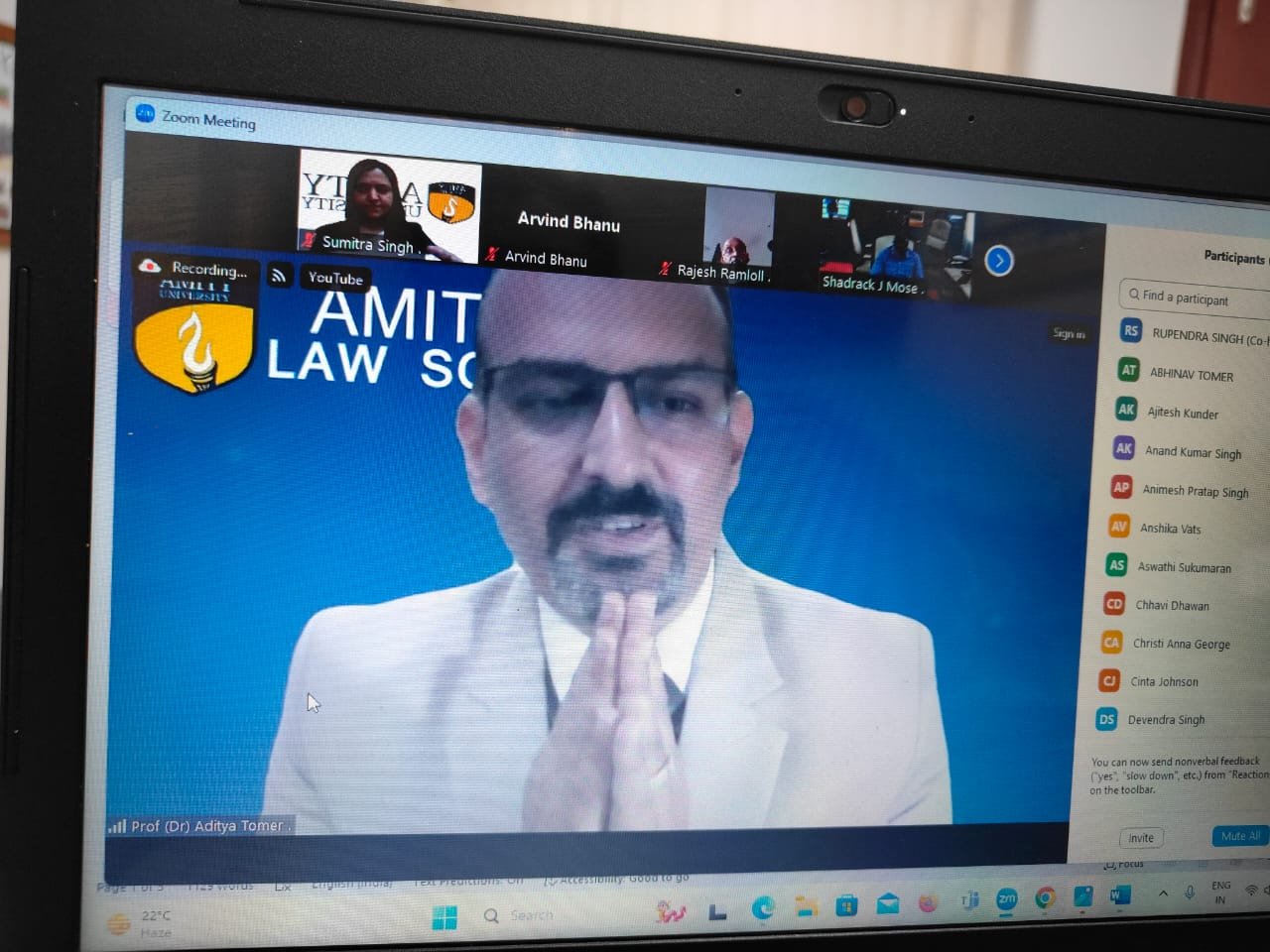
comparative constitutional law accords as an opportunity to seek Excellency and promote constitutionalism and good governance -Hon’ble Shadrack J Mose, Solicitor General of the Republic of Kenya
Amity University organised two days INTERNATIONAL CONFERENCE ON COMPARATIVE LAW, 2024. The valedictory ceremony commenced with the welcome of the distinguished guests. The welcome was done by Dr. Sumitra Singh, Associate Professor, Amity Law School, Noida. The guests consisted of Hon’ble Mr Shadrack J. Mose, Solicitor General of the Republic of Kenya, Mr Alfred Tuah-Yeboah, Deputy Attorney General and Minister for Justice, Ghana, Hon’ble Ms Najat Abou Chacra, Investigative Judge, Military Court, Beirut, Lebanon, Mr Rajesh Ramloll SC, Deputy Solicitor General of Mauritius, Mr N. Venkataraman, Additional Solicitor General of India, Dr. Ashok Chauhan, Hon’ble Founder President, Amity University, Dr. Atul Chauhan, Hon’ble Chancellor, Amity University, Uttar Pradesh. The welcome was followed by invocation & lightening of the lamp and a virtual presentation of tulsi sampling. This ceremony was held online on Zoom.
Prof. (Dr.) Aditya
Tomer, Joint HoI,
Amity Law School, Noida addressed the
gathering and thanked the various dignitaries for sparing their valuable time
for the event. He stated that law is developed and evolved in many ways
comparing the laws of different nations or even cultures provides a unique way to
develop law in a better manner. He also thanked all the esteemed guests from
different parts of the country and overseas, the students, the teaching, and
the non-teaching staff for attending this event in online and offline mode.
Prof.
(Dr.) D. K. Bandyopadhyay, Chairman, Amity Law
School, Noida, Chief Adviser (FPO, Amity Group), expressed his privilege
to be a part of this conference. He quoted “India is such a country where many
people come, many contribute, many learn out of the country, they give
something to us and take something from us and this is the nobleness of our
country”. He thanked dignitaries on behalf of the whole Amity family and
congratulated the organizing committee, volunteers, and staff.
Hon’ble
Shadrack J Mose, Solicitor General of the Republic of Kenya, expounded
upon the topic of comparative constitution, and he spoke about the constitution
of Kenya and its reforms. He also spoke about the socio-economic rights of the
people. He highlighted all the constitutional evolution of Kenya. Against the backdrop of rapid cultural
change and technological acceleration. Countries continue to face similar
governance problems, even with different cultural, political, religious, and legal
histories. Similarities and differences provide a basis for continued
comparative ability, esteemed colleagues as we celebrate and share experiences
from the study of comparative constitutional law and its outcome. He stated
that he encourages people to be guided by the words of Abraham Lincoln. He has
the right to criticize who has had to help. He concluded by saying that he wishes
to reiterate that comparative constitutional law accords as an opportunity to
seek Excellency and promote constitutionalism and good governance aimed at
promoting the common good at the national and international levels. He
expressed his immense gratitude to be a part of this conference and thanked
Amity Law School, Noida.
Mr.
Alfred Tuah-Yeboah, Deputy Attorney General
and Minister for Justice, Ghana, addressed the gathering by stating
that he was humbled and honoured to be a part of the conference organized by
one of the finest universities of India. He talked about the historical
background of the constitution of Ghana and provided insights into the judiciary
system of Ghana. He appraised “International law and diplomacy”.
He
presented to the audience the beautiful republic of Ghana, situated in West
Africa along the Gulf of Guinea. He provided information about Ghana and mentioned
that it is home to approximately 34.5 million people. To delve into the
constitutional history of Ghana, he proposes taking the audience back in time
for a better appreciation of how the constitution has endured. Independence was
achieved in 1957, adopting the British governance system, with Dr Kwame Nkrumah
as the first Prime Minister under the 87 constitution.
He
went back in history to explain that in 1960 Ghana transitioned to its first
republican constitution during Kwame Nkrumah’s presidency, removing the British
monarch’s control. Subsequently, the country faced military interventions,
leading to the abrogation of the constitutional dynasty in 1966. Ghana then
adopted another constitution, following the Westminster type of government,
with a Prime Minister and a ceremonial president. However, this constitution
was also toppled in 1972 by another military intervention.
The
period from 1972 to 1979 saw military rule, with elections held in 1979 under a
new constitution. This constitution established a presidential system of
government, devoid of a Prime Minister. Unfortunately, by 1981, another
military intervention led to the abrogation of this constitution, keeping Ghana
under military rule until 1992.
He
further added that in 1992, Ghanaians, led by the late John Rollins, came
together to formulate a new constitution. This 1992 Constitution was emphasized
as resilient and withstood the test of time. Under this constitution, Ghana
operates a presidential system with an executive president appointing cabinets
and ministers. The separation of powers among the executive, judiciary, and
legislature is outlined, noting a lack of a watertight separation, particularly
due to the fusion of the executive and legislative branches.
In
its role as a democratic state, Ghana’s 1992 Constitution includes detailed
provisions on civil liberties, dedicating an entire chapter to these rights.
The constitution enshrines fundamental rights and liberties, emphasizing its
commitment to upholding civil liberties within the democratic framework. He
concluded by thanking the organizers for making him a part of this conference.
Hon’ble
Ms. Najat Abou Chacra, Investigative Judge, Military
Court, Beirut, Lebanon stated that she is privileged to be a part of this
conference. She talked about “human rights in the Lebanese constitution. She
spoke about different articles which enlightened us about the constitution of Lebanon. She touched
upon the topic of criminal and civil laws as well. The focus centred on the
Lebanese constitution of 1990, post-Civil War, particularly emphasizing
articles related to human rights. She narrowed the focus to Article Seven, highlighting
equality before the law. She subsequently delved into various constitutional
articles, such as Article Eight concerning individual liberty, and Article 10
regarding the right of conscience.
She
accentuated the absence of explicit litigation rights, notably in guaranteeing
fair prosecution and trial. She mentioned about the Code of Criminal Procedure
and penal code filling these gaps, addressing rights like the right to remain
silent, legal assistance, and appeal. Economic and political rights, such as
the right to work and self-determination which are not expressly stipulated in
the constitution but are considered fundamental by Lebanon, aligning with
international conventions and the Universal Declaration of Human Rights.
The
preamble of the Lebanese constitution asserts Lebanon's commitment to the
United Nations Organization and the Universal Declaration of Human Rights. The
Constitutional Council affirms that these principles hold constitutional value,
treating them as integral to the constitution itself. The duty of the
government and judiciary to respect and implement international conventions is
highlighted, even when not explicitly outlined in domestic laws. The
Constitutional Council further establishes that the right to work and the right
to self-determination are fundamental rights emphasizing their constitutional
importance.
In
conclusion, she asserted that Lebanon, as a state, its government, and its
judiciary uphold international conventions safeguarding human rights
demonstrating a commitment to principles beyond those explicitly outlined in
constitutional or ordinary laws. She felt deeply honoured and thanked the
organizing committee.
Mr Rajesh
Ramloll SC, Deputy
Solicitor General of Mauritius
commenced addressing the audience by showing his gratitude to Dr. Sumitra
Singh for welcoming him. He stated that he would be talking about the issue
of artificial intelligence, technology, and its impact on access to justice. The
intersection of AI technology and access to justice is a complex and evolving
issue globally including in Mauritius. Training legal professionals in AI and
technology can enhance their capabilities and improve the overall legal system.
There may be challenges in ensuring that legal professionals have the necessary
skills and understanding of AI tools. Additionally, efforts should be made to
prevent a digital skills gap. Technology can reduce costs associated with legal
processes, making legal services more affordable. The initial costs of
implementing AI systems and technology can be high. Ensuring that the benefits
reach all segments of society, especially those with limited financial
resources, is crucial. He further spoke about how AI is aiding in achieving
success in the legal justice system quoting a statistic of 94%. First Ai has
the potential to bring and defend without legal representatives. He cited
various interpretations of the Civil Court Structure Review Report 2016.
He further enlightened the audience by
stating that AI-powered tools can quickly analyse vast legal databases,
statutes, and case law to provide legal professionals with relevant
information, precedents, and insights. Automated legal research tools can
assist individuals in understanding their legal rights, obligations, and
potential courses of action. He also added that AI can automate the creation
and management of legal documents, reducing the time and cost associated with
manual document drafting. He further stated that AI algorithms can analyse
historical case data to predict potential case outcomes, helping legal
professionals and litigants make more informed decisions.
He concluded by stating that there are
various issues as well in using AI in the access to justice. He stated that
nonetheless, AI has amazing tools, but human intelligence is way more
significant in comparison to AI tools. He ended his speech by thanking the
organizers of this conference.
Dr.
Ashok K. Chauhan, Hon’ble Founder President, Amity
Education Group, Ritnad Balved Education Foundation; Chairman, AKC Group of
Companies, addressed the gathering after Dr. Sumitra Singh introduced
him to the audience. He commenced by stating that this conference is always
very close to his heart as this conference makes the students reach knowledge
at an international level. He further stated that he carefully listened to the
speech of the esteemed guests, especially Mr Rajesh
Ramloll SC, Deputy
Solicitor General of Mauritius
and expressed his proposal by requesting Mr Rajesh
Ramloll SC to provide
lectures to his students globally. He thanked the organizers for conducting
such an amazing conferencing which has empowered the participants with immense
knowledge. He threw some light on the importance of comparative law and why
such a conference plays a vital role in learning for law students.
Mr
N. Venkataraman, Additional Solicitor General of
India commenced addressing the audience by thanking the organizers and
welcoming all the Guests of Honours. He spoke about the harmonization of laws.
He focussed on three areas of common interest, the first being the investment.
He stated that investments are not only from capital-exporting countries to
developing nations, but it goes beyond that. Even today when we decide on laws
and how the law is progressed, there is a distinction between a nation’s law
and the role of a nation in international law development. Business laws and investments
have been essentially bilateral, and several other laws are also bilateral.
He
stated that the second area of common interest is the investigation. He identified
that there are several investigating agencies in India and the common challenge
faced by developing nations is whether our territory is being used for
laundering. The big disconnect in investigation law is the speed at which the
violator operators and the speed at which we try to connect with other nations
to seek help and in terms of red tape in terms of trying to harmonize what each
nation wants or the speed at which a crime gets committed and a criminal move
across. He mentioned that once money or a criminal moves out of a country, it
is a challenge to bring it back.
Further
speaking he specified that the third area of common interest is the
adjudication process. There is universal thinking in cross-border transactions
that we cannot rely on one nation’s courts or justice system. The issues are
common amongst the developing nations thereby hands must be joined to overcome
these challenges and issues in ensuring to calibrate the legal system with
greater harmony to become a unified force in the global space. He concluded by
stating the ideology of Hon’ble Prime Minister of India Mr. Narendra Modi that
it is a must to have a judicial space which is unified and harmonized along
with economic and political development.
Presentation of
Citations:
Reading
of citations in honour of all the dignitaries present was done by Dr. Jane
Eyre Mathew, Assistant Professor, Amity Law School, Noida in the following
order:
·
Mr. N. Venkataraman
·
Hon’ble Ms. Najat Abou
Chacra
·
Mr. Rajesh Ramloll SC,
·
Mr. Alfred Tuah-Yeboah,
·
Hon’ble Shadrack J.
Mose.
All
the dignitaries accepted their citations with content.
Announcement of Best
Paper Award:
Results for the Best Paper Award of the 5th International Conference on Comparative Law was announced by Mr Rupinder Singh, Assistant Professor, Amity Law School, Amity University, AUUP.
Vote of Thanks:
Vote
of Thanks by Prof. (Dr.) Arvind P. Bhanu, Additional Director/Jt. HoI,
Amity Law School, Noida. proposed the Vote of Thanks. He thanked the
distinguished guests for sparing their precious time and expounding their deep
knowledge of the subject matter. He also expressed his gratitude towards Dr
Ashok K. Chauhan, Hon’ble Founder
President, Amity University, Dr. Atul Chauhan, Hon’ble Chancellor, Amity
University, AUUP and Prof. (Dr.)
Balvinder Shukla, Hon’ble Vice-Chancellor, Amity University, AUUP for
providing such a great opportunity and providing support for organizing this
International Conference. He also spoke about the wonderful insights delivered
by various Guests leading this conference to become a platform of learning.
The
ceremony concluded with Dr. Sumitra Singh thanking all the dignitaries,
participants, and organizers for this wonderful conference.




संबंधित पोस्ट


Follow Us On




Subscibe Latest News
SUBSCRIBE US TO GET NEWS IN MAILBOX
Image Gallery

लाइव क्रिकेट स्कोर
शेअर मार्केट
Website Poll


 इस वेबसाइट के सभी लेख DMCA कॉपीराइट प्रोटेक्टेड हैं। कॉपी या किसी भी रूप में किसी भी सामग्री का उपयोग करना एक गंभीर अपराध है।
रिपोर्टर
The Reporter specializes in covering a news beat, produces daily news for Aaple Rajya News
Dr. Rajesh Kumar